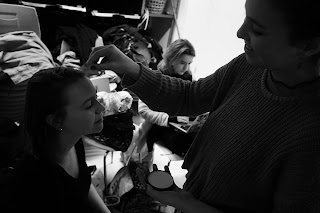
The Production Team
Director- Rebecca Speller
Producers- Natalie Denton, Philippa Douglas & Rahel Morten
The Cast
Hecuba: Laura Burnett
Talthybius: Jasper Bartlett
Cassandra: Bethan Lloyd
Andromache: Lucy Chappell
Menelaus: Luke Seabright
Helen: Hannah Baker
Poseidon: Thomas Smith
Athena: Hannah Harris
Chorus: Eleanor Collerton
Faidra Faitaki
Wiebke Green
Soryah Haggarty
Aislinn O'Reilly
Fiona Padfield
Lucille Steward
Amanda Tavares
Soldiers: Joao Francisco Fisher
Howard Horner
Luke McEvoy
William Van Mossevelde
Freddie Wilson
UCL Greek Play blog
Saturday, 8 December 2012
Tuesday, 4 December 2012
The UCL Classical Play 2013 is Euripides' Trojan Women, in a translation by Alan Shapiro.
The war is over. Troy has fallen. Abandoned by their gods and bereft of their men, the city's women wait inside a prison camp to be shipped off to a life of slavery, and discover that their suffering is far from over. Euripides' tragedy offers a deeply moving evocation of the horrors of war, but also an enduring picture of human fortitude in the midst of despair. This production, set in World War II, showcases the continuing relevance of one of the most powerful anti-war plays ever written.
Produced in Athens in the spring of 415 BC, Euripides' Trojan Women dramatises the aftermath of war by focusing on the unique perspective of the captive women of Troy. Led by their former queen Hecuba, the women bemoan their fallen city and the prospect of a new life in a foreign land as slaves of the savage conquering Greeks. A timeless tale of defeat and destruction, the play gives voice to the grief and experience of women in war.
Euripides (c. 480-c. 406 BC) was the youngest and most provocative of the three great Athenian tragedians. Though he wrote about ninety plays, only nineteen survive. Trojan Women was produced when Euripides was sixty-nine years old as the final part of a trilogy consisting of two lost plays, Alexandra and Palamedes along with a satyr play, Sisyphus. It was awarded second prize at the Great Dionysia festival in Ancient Athens.
Ancient Plays for Modern Minds: A Public Engagement Programme
To complement the production of Trojan Women, we shall be offering a series of talks and workshops which aim to illuminate the play and its context and to bring Euripides to life for a modern generation. This exciting programme includes talks by academic experts on ancient drama and its reception, as well as interactive workshops by contemporary theatre practitioners. There are events on every day of the play’s performance, and each talk or workshop deals with an important angle of interpreting or performing the play. All of our speakers have experience in working with schools, and the events will be suitable for students of Classics, Classical Studies, and Drama, as well as accessible to those without prior experience of Greek drama.
Schedule for 2013
All events are free of charge and open to all. However, the participatory nature of the workshops means that space is limited, and pre-booking is therefore essential. We would also recommend pre-booking for the lectures, in order to avoid potential disappointment on the day: please reserve places for your group by emailing Rosa Andújar. The workshops will last approximately 2 hours; the talks will last approximately 45 minutes, with time for questions at the end. Please note that workshop participants should be aged 16 and above.
Tuesday 5th February 3.15-5.15pm - Participatory Workshop: David Stuttard: 'What's Hecuba to Him?'
6.00-7.00pm - Public Talk by Professor Simon Goldhill (Cambridge). Venue: Roberts Building G08, Sir David Davies Lecture Theatre.
Wednesday 6th February 3.15-5.15pm - Participatory Workshop: Russell Bender: 'Physical Approaches to the Greek Chorus'.
6.00-7.00pm - Public Talk by Professor Chris Carey (UCL). Venue: Roberts Building G06, Sir Ambrose Fleming Lecture Theatre.
Thursday 7th February 3.15-5.15pm - Participatory Workshop: Deborah Pugh: 'Pushing The Space In Choral Work'
6.00-7.00pm - Public Talk by Dr Rosa Andújar (UCL). Venue: Wilkins Building, Second Floor, Gustave Tuck Lecture Theatre.
The war is over. Troy has fallen. Abandoned by their gods and bereft of their men, the city's women wait inside a prison camp to be shipped off to a life of slavery, and discover that their suffering is far from over. Euripides' tragedy offers a deeply moving evocation of the horrors of war, but also an enduring picture of human fortitude in the midst of despair. This production, set in World War II, showcases the continuing relevance of one of the most powerful anti-war plays ever written.
Produced in Athens in the spring of 415 BC, Euripides' Trojan Women dramatises the aftermath of war by focusing on the unique perspective of the captive women of Troy. Led by their former queen Hecuba, the women bemoan their fallen city and the prospect of a new life in a foreign land as slaves of the savage conquering Greeks. A timeless tale of defeat and destruction, the play gives voice to the grief and experience of women in war.
Euripides (c. 480-c. 406 BC) was the youngest and most provocative of the three great Athenian tragedians. Though he wrote about ninety plays, only nineteen survive. Trojan Women was produced when Euripides was sixty-nine years old as the final part of a trilogy consisting of two lost plays, Alexandra and Palamedes along with a satyr play, Sisyphus. It was awarded second prize at the Great Dionysia festival in Ancient Athens.
Ancient Plays for Modern Minds: A Public Engagement Programme
To complement the production of Trojan Women, we shall be offering a series of talks and workshops which aim to illuminate the play and its context and to bring Euripides to life for a modern generation. This exciting programme includes talks by academic experts on ancient drama and its reception, as well as interactive workshops by contemporary theatre practitioners. There are events on every day of the play’s performance, and each talk or workshop deals with an important angle of interpreting or performing the play. All of our speakers have experience in working with schools, and the events will be suitable for students of Classics, Classical Studies, and Drama, as well as accessible to those without prior experience of Greek drama.
Schedule for 2013
All events are free of charge and open to all. However, the participatory nature of the workshops means that space is limited, and pre-booking is therefore essential. We would also recommend pre-booking for the lectures, in order to avoid potential disappointment on the day: please reserve places for your group by emailing Rosa Andújar. The workshops will last approximately 2 hours; the talks will last approximately 45 minutes, with time for questions at the end. Please note that workshop participants should be aged 16 and above.
Tuesday 5th February 3.15-5.15pm - Participatory Workshop: David Stuttard: 'What's Hecuba to Him?'
6.00-7.00pm - Public Talk by Professor Simon Goldhill (Cambridge). Venue: Roberts Building G08, Sir David Davies Lecture Theatre.
Wednesday 6th February 3.15-5.15pm - Participatory Workshop: Russell Bender: 'Physical Approaches to the Greek Chorus'.
6.00-7.00pm - Public Talk by Professor Chris Carey (UCL). Venue: Roberts Building G06, Sir Ambrose Fleming Lecture Theatre.
Thursday 7th February 3.15-5.15pm - Participatory Workshop: Deborah Pugh: 'Pushing The Space In Choral Work'
6.00-7.00pm - Public Talk by Dr Rosa Andújar (UCL). Venue: Wilkins Building, Second Floor, Gustave Tuck Lecture Theatre.
Thursday, 16 February 2012
some thoughts
A month after we were introduced to the blog, and almost a week after the final performance, I (Charlie/Hippolytus) have decided to stick some thoughts down in nostalgia. Just want to say I had a tip top time first of all. things I will remember fondly are getting bloodied up in the wings twice a day for three days, musical buzzy bees, pretending to be a sexy deer with Christian in our first rehearsal, playing in general for long periods during rehearsals, doing pilates in the wings, the threat of being slapped with a fish before going on stage. many things I guess. and performing to over 500 people man! crazy people, crazy fun.
Review in The Times
Tragicomic Performance
Hippolytus was anything but cheerful. Blood all over the place. But what a performance! I’ve hardly read Euripides and never seen his work staged, but Ann Carson’s translation was thrillingly vernacular and the UCL Classical Drama Society’s production explosive. Like so much classical stuff it’s all about sex and violence: Aphrodite’s revenge on the young man who wants purity more than her body. The wicked goddess fills his stepmother with desire for him, driving her to suicide and inflaming his father with rage. And boy, is the son’s ending violent, dragged across the rocks by his own horses.
Among powerful performances by Eleanor Wright (The Nurse) and Rohan Pai (the messenger), both wonderfully natural, Charlie Satow really stood out as Hippolytus. It’s curious to watch a player teetering on the cusp (as Laurence Olivier sometimes did) between sheer brilliance and ham.
With Satow you were at one moment gripped by his passionate innocence, sincerity and lovely poetic diction… and the next stifling a giggle at one convulsion too many in his death throes, whispering “don’t overact” and feeling sneaking sympathy for Aphrodite’s impatience with his whinnying self righteousness. But a great performance by Satow, a great play and, in a rather different way from the White Swan, a great night.
- Matthew Parris, The Times, p26, 16/02/12.
Wednesday, 8 February 2012
Artemis, Hippolytus, and sexuality
Before the play’s first performance yesterday, we had a
fantastic lecture by Professor Judith Mossman from Nottingham University, who
spoke eloquently about the role of the gods in Hippolytus. One of the things that Judith stressed in her lecture
was the importance of distinguishing between what Hippolytus thinks Artemis
represents, and what the audience would have understood about Artemis from
their own religious experience. I thought this was a very important insight,
and it got me thinking about how this relates to the research I’ve done in the
past on the play, particularly with regard to gender and sexuality.
It can be tempting to see Artemis and Aphrodite as polar
opposites, and as representing opposing forces in human life: Artemis as purity
and chastity, Aphrodite as unbridled sexuality. In the play, this perspective is
compounded by the attitudes of the goddesses’ human agents: Hippolytus, the servant
of Artemis, rejects all forms of sexuality, while Phaedra, who acts as
Aphrodite’s unwitting agent, is consumed by uncontrollable desire. Yet within
the play we find several clues that this extreme position represents only a
partial account of the goddesses’ true nature, and the role that they played in
religion and society.
While Artemis is a virgin goddess, and the patron of
unmarried girls, in Greek life, virginity was always a temporary state which looked
forward to a change: the main purpose of a Greek girl’s life was to marry and
produce children. Although poetry which deals with young girls’ transitions
often expresses reluctance and fear regarding these life changes, it does so in
a context which celebrates the transition as a positive and important event. In
religion, this is reflected by Artemis’ status as the patron of childbirth as
well as virginity: her role was to guide girls in their journey from maidens to
mothers, and to protect them during this final and most dangerous transition.
Yet Hippolytus perceives Artemis as representing eternal virginity, and any
form of sexuality posing a threat to her worship. This is encapsulated in his
first scene, when he offers her a garland from an ‘untouched meadow’, which has
never known agriculture or pasture, and which only those who are sophron (chaste or self-controlled) can enter.
The meadow in Greek thought represents a potential location for seduction; a
lush and attractive wilderness in which young girls in myth are frequently
seduced, or even abducted, yet Hippolytus here attempts to sanitise the meadow,
and present it as a controlled and sealed environment. This is reinforced by
the prayer at the end of his speech to ‘end life’s race as I began it’; yet
trying to resist change and adulthood is a futile effort, and one which
disregards the important religious role that Artemis held in this sphere.
Similarly, Hippolytus’ view of Aphrodite as representing uncontrolled
lust is also out of kilter with her real worship. We are reminded of this by
the Nurse, who tells Phaedra that Aphrodite is unbearable in full force, but gentle
to those who yield to her. While Phaedra’s adulterous lust for Hippolytus would
have been considered deeply distasteful, a Greek audience would also have
understood that Aphrodite as goddess of love and desire, has an important place
in society: specifically within the bounds of marriage. We are reminded of the
possibility of sexuality as a positive force in human life in the chorus’
second stasimon, where they imagine flying away as birds to the ends of the
earth, and imaging coming to the garden of the Hesperides, where Zeus and Hera consummated
their marriage. Here we find an alternative garden to Hippolytus’ airtight
meadow; one which allows human love and fertility to be celebrated, while the
marriage of Zeus and Hera stands as a prototype for all human marriages. Our
directors have taken the decision to stage this ode as a dance between the male
and female choruses; this further enhances the marital imagery in the song, and
offers the possibility of a harmonious relationship between the sexes, which
the characters in the play are tragically unable to attain.
In conclusion, then, we should not be tricked into accepting
Hippolytus’ polarising view of the two goddesses, a view which is rooted in his
own profound inability to accept sexuality as a natural part of the human
experience. Rather, the play reminds us that Artemis and Aphrodite can
represent a continuum of human life, even if this aspect is something that the
characters in the play are unable themselves to experience. (Laura Swift)
Tuesday, 7 February 2012
Opening Night - These Being The Nocturnal Ramblings Of Nakul Pande
So...we got through the first night. Actually, that is one hell of an understatement: tonight was a resounding success, and I feel I should give you my take on exactly why that was the case.
It's been approximately four hours since the first performance ended, and though the adrenaline still hasn't quite worn off I'll do my best to give you a coherent picture of what the big night is like for those of us lucky enough to get to tread the Bloomsbury boards. This is my third consecutive year in the UCL Greek Play, and in my experience the first night is a generally a very nervy affair - not so much performing as attempting to overcome a series of minor (and occasionally major) crises in front of 300-500 people who may or may not want to be there. As a result the product that is presented to the audience tends to leave a bit to be desired in terms of intensity.
Tonight was different. Maybe it was the first unveiling of the full costumes. Maybe it was the 7pm psyche-up session in the green room. Maybe it was just the coffee. But from the first spellbinding frame of the projection of Aphrodite to Theseus' final despairing lament, every single actor was fully locked in to what they were meant to be doing and why. In particular the choruses - of which I am proud to call myself a member - seemed to take to heart the directors' instructions to outdo each other emotionally speaking, which created a virtuous circle - the strong and at times vocal reactions of the chorus drew in even the most easily distracted members of the audience, thus providing the principal characters (especially Hippolytus, Phaedra and Theseus) with the perfect atmosphere in which to really commit to Anne Carson's powerful translation, which in turn gave the chorus the confidence to react vigorously to the crescendo of horror taking place in front of them. Being in the chorus gives you the unique opportunity to both be involved in and watch the action simultaneously - indeed, within the context of the play we are the first audience, with the people in the seats a step further removed - and this rare synergy of leads, chorus and spectators was especially notable during the closing scene where Theseus and his mortally wounded son are poignantly re-united after the revelations of Artemis - there were real tears cried tonight. For someone of my very limited acting range, being able to work off people who can be so emotionally in the moment is a gift.
Vaguely-expressed thespian gubbins aside, the energy levels of everyone even vaguely involved tonight were incredible, which made the whole night a seriously enjoyable experience. Well done, every last one of you. Let's have more of the same tomorrow please (well, today now if we're being pedantic).
Nakul Pande, male chorus
Sunday, 5 February 2012
only a few days to go...
As the chorus run through their dance, I had a quick word
with Louise, who plays the Goddess Aphrodite, and asked her about her play
experiences:
How are you feeling
now there are only a few days to go?
It’s a little bit surreal. Particularly for me as I have not
been in as many rehearsals as the chorus, who have been rehearsing since
Christmas. I think when we get into the theatre it will start to feel more
real.
Yes. It’s been really good. It was much more one on one for me, as my character has no
interaction with the main cast. The filming (for the projected video) was really
good. It was horrendously cold though!
How have you gone
about embodying the Goddess of Love and Desire?
(says something I cannot put into print!) No, don’t put that
in! I’ve gone about analysing the emotions in the script - what she wants and
why. And also understanding that confidence – she can do whatever she wants –
she IS sex and beauty – she is all of those things. It’s trying to get that
complete and all encompassing confidence, and conveying that. It would have
been easy to say, “I’m so sexy” and be obvious, like when girls put on loads of
make up, and act a certain way. But it’s more than that, it’s the complete and
unfaltering belief that she is the most beautiful, that she IS desire. Desire
can be terrible and dark, and she is embodying that side of things and is
abusing it simply because she can.
Has there been
anything unique about acting in a Greek Tragedy, as opposed to any other form
of theatre?
I think that didn’t affect me as much as the chorus. The
lines, because it’s a translation, are a bit stylised. But because I don’t have
to interact as much, it didn’t affect me. But I think it will be accessible.
What have the
Producers been up to?
This last week has been very stressful for all involved. We
have been signing contracts and organising the crew, whilst trying to attend
the rehearsals to see how the play is progressing.
One of the major pieces of work was finalising the programme
available for purchase at the performance. Abi and I, as producers, put it
together and, considering we have no experience in graphic design, we are
really proud of the result. The cover image is the same as the poster, which
features the picture taken for us by one of our directors, Illy. But the inside
is just as important, and we are so thankful to the academic staff of the Greek
and Latin department UCL, who have contributed articles to help explain the
history, symbolism, and significance of Hippolytus. We hope this programme will
provide a valuable academic resource for the school groups who have booked
seats. You can also find the original drawings of the costumes, cast
biographies, and information about organisations and events to do with Classics
around London.
One of the issues with student theatre is that a careful
balance must be struck between our focus on putting on an amazing play and
academic work. Combining rehearsals and class timetables and essays can mean
that not everyone can attend all rehearsals, and this can mean that we do not
run through the complete play until the dress rehearsal. This does not make for
a relaxing experience, as there is always the fear that someone has been
overlooked, or one scene is not run through enough, but the lines are learned
and the dances choreographed and it looks amazing. Everyone involved has been working hard to complete their
coursework before Playweek, and now we are at liberty to devote ourselves to
the play for the next few days.
Abi and I are here for the final run-through, and we are blocking the
performance in order to give our backstage crew the most detailed notes
possible at the Tech rehearsal tomorrow. We have makeup artists, prop managers,
and stage crew awaiting instruction and the wonderful Jo Golding at the
Bloomsbury has designed our lighting.
So with the programmes made, the rights signed off on, and
the crew raring to go, we are ready for playweek to begin!
Emily
(Producer)
Subscribe to:
Posts (Atom)